Why “AI Automation Risks for Workers” Matters Now
AI is no longer a future concept—it’s in hiring tools, customer support, coding assistants, design software, and everyday workflows. For many workers, this means faster tasks and new opportunities. For others, it brings anxiety about replacement, reduced control, and skills that feel less valuable.
This article focuses on AI automation risks for workers as the primary lens. We’ll cover:
- How AI is replacing and reshaping tasks and roles
- The real risks of job displacement, over-reliance, and work intensification
- The flip side: smart work, faster workflows, and how to position yourself in an AI-driven workplace
Whether you’re an individual contributor, manager, or business owner, the goal is the same: clear awareness, realistic perspective, and practical steps you can use today.
Internal link idea: If you’ve read our piece on software myths and realities, this is the natural next step—moving from “what software is” to “what AI automation is doing to work.”
AI Automation: What’s Actually Happening in the Workplace
AI automation uses algorithms and models to perform tasks that previously required human judgment or effort. In practice, this looks like:
- Customer service: Chatbots and AI agents handling routine queries.
- Data work: Automated data entry, reporting, and analysis.
- Creative and knowledge work: AI drafting emails, documents, code, and designs.
- Operations: Scheduling, inventory, and workflow optimization powered by AI.
The headline reality: AI will reshape more jobs than it fully replaces, at least in the near term. Many roles will remain, but the day-to-day tasks inside those roles will change significantly.
The Replacement Question: Is AI Taking Our Jobs?
What the data says
- Studies suggest a significant share of jobs will be reshaped by AI in the next few years, with a smaller but still important percentage potentially eliminated over time.
- Some roles—especially repetitive, rule-based tasks—are at higher risk: customer service, data entry, certain admin and clerical roles, and parts of programming, accounting, and legal work.
- At the same time, new roles are emerging: AI oversight, data quality, prompt engineering, AI-augmented analysis, and domain-specific AI specialists.
Key perspective: It’s less “AI vs humans” and more “which tasks get automated, and how humans adapt.”
Who is most exposed?
- Clerical and administrative roles face high exposure to partial automation.
- Women in certain sectors and lower-skilled workers often face higher risk of role transformation and reduced job quality, even if the job doesn’t disappear.
- White-collar roles with routine cognitive tasks (e.g., some analysts, junior developers, content editors) are also seeing significant AI impact.
This doesn’t mean “no future,” but it does mean transition pressure: reskilling, role redesign, and sometimes career shifts.
Internal link idea: Connect this to your coding-awareness piece: “If you’re in tech, see our article on coding myths and realities to understand how AI is changing developer work.”
Smart Work and Faster Workflows: The Positive Side of AI Automation
AI isn’t only a threat; it’s also a powerful lever for smart work and faster workflows.
Where AI helps workers
- Productivity gains: Many workers report AI improves performance and, in some cases, job enjoyment.
- Task acceleration: Drafting, summarizing, translating, coding, and data cleaning become faster, freeing time for higher-value work.
- Decision support: AI can surface patterns in data, flag anomalies, and suggest options, supporting—not replacing—human judgment.
Smart work vs. hard work
- Hard work: Doing everything manually, reinventing the wheel, repeating the same tasks.
- Smart work: Using AI to handle routine parts, then focusing human effort on judgment, creativity, relationships, and strategy.
The workers and organizations that thrive will be those who treat AI as a collaborator, not a competitor.
The Dark Side: AI Automation Risks for Workers
Awareness is crucial. The same tools that enable smart work can also create serious risks if deployed without care.
- Job displacement and role transformation
- Partial automation can reduce responsibilities, stagnate wages, and increase insecurity, even when jobs don’t fully disappear.
- In some sectors, AI may lead to significant job displacements, especially where tasks are highly repetitive and standardized.
- Workers may experience fear of job insecurity, loss of identity, and diminished sense of value as tasks they once owned are automated.
Reality check: Displacement is not uniform. Some roles shrink, some change, some grow. The risk is highest where tasks are predictable and data-rich.
- Over-reliance and skill erosion
When AI use becomes unchecked:
- Cognitive skills can erode. Employees delegate too much thinking to AI, reducing critical analysis, problem-solving, and learning opportunities.
- Expertise weakens. Over time, heavy reliance on AI for drafting, coding, or analysis can make people less capable of doing the work without it.
- Mentorship suffers. If juniors rely on AI instead of learning from seniors, knowledge transfer and team cohesion decline.
This is the over-reliance danger: short-term speed at the cost of long-term capability.
- Work intensification and psychosocial risks
AI can unintentionally increase pressure:
- Faster pace expectations: When AI speeds up tasks, management may expect more output in the same time, raising stress.
- Repetitive residual work: Automation can leave workers with narrow, monotonous tasks, causing boredom and cognitive underload.
- Isolation: More interaction with AI systems and less with human peers can reduce social support and harm mental health.
These are not just “tech issues”; they’re workplace health and safety issues.
- Bias, surveillance, and inequality
- Bias in AI systems can affect hiring, performance evaluation, and task allocation, reinforcing existing inequalities.
- Data collection and monitoring can increase surveillance, reducing autonomy and trust.
- Inequality risks: Benefits of AI may concentrate among high-skilled workers and large firms, while others face more disruption.
AI Over-Reliance Dangers: When “Faster” Becomes Risky
Over-reliance is one of the most subtle but damaging AI automation risks for workers.
Signs of over-reliance
- Accepting AI outputs without review, especially in important decisions. [84]
- Inability to explain or reproduce work without AI assistance.
- Declining confidence in doing core tasks manually.
- Teams that no longer discuss “how” work is done, only “what AI produced.”
Consequences
- Errors at scale: A single flawed AI pattern can propagate across many decisions before being caught.
- Loss of accountability: “The AI did it” becomes an excuse, even though humans chose and deployed the system.
- Reduced resilience: When AI tools fail or change, teams struggle to fall back on human processes.
Healthy use rule: AI should augment judgment, not replace it—especially in high-stakes contexts.
Development of AI Automation: Where This Is Heading
AI automation is not a one-time change; it’s an ongoing shift.
Near term (1–3 years)
- Task-level automation expands rapidly: drafting, summarizing, coding assistance, basic analysis.
- Many jobs will be reshaped more than eliminated, with new workflows and role expectations.
- Organizations that rush implementation without training or governance will see engagement drops and operational issues.
Medium term (3–7 years)
- More complex workflows become automated end-to-end, especially in data-heavy functions. [82][86]
- Some occupations will shrink noticeably; others will evolve into AI-human hybrid roles. [81][89]
- Pressure to reskill and adapt will intensify, particularly for workers in highly exposed roles.
Long term (7+ years)
- AI will be deeply embedded in most knowledge and service work.
- The key differentiator will be human judgment, domain expertise, and ethical oversight, not just tool usage.
How Workers Can Respond: Practical Strategies
You don’t need to be an AI expert to manage AI automation risks for workers. You do need a clear plan.
For individual contributors
- Learn to work with AI, not just use it.
- Understand what your AI tools do, where they fail, and how to verify outputs.
- Treat AI drafts as starting points, not final answers.
- Protect your core skills.
- Regularly do key tasks without AI to keep your skills sharp.
- Use AI to explore options, but make final decisions yourself.
- Focus on irreplaceable strengths.
- Relationships, negotiation, complex problem-solving, creativity, and ethical judgment are harder to automate.
- Document your AI-augmented work.
- Keep records of how you use AI, what you verify, and where you add value. This strengthens your case in reviews and promotions.
For managers and leaders
- Design human-centered AI workflows.
- Identify which tasks AI should handle, where humans must stay in control, and how handoffs work.
- Avoid “AI everywhere” mandates; be selective and intentional.
- Invest in reskilling, not just tools.
- Offer training on AI literacy, critical evaluation, and new role expectations.
- Create time for learning and experimentation, not just output targets.
- Monitor risks, not just productivity.
- Track work intensity, stress levels, and feelings of agency among teams.
- Watch for signs of over-reliance, skill erosion, and reduced collaboration.
Internal link idea: Tie this to your software-awareness piece: “For a broader view on tech risks, see our article on software: reality, awareness, and the dark side.”
Myth vs Reality: AI Automation and Work
| Myth | Reality |
|---|---|
| AI will replace most jobs soon | AI will reshape more jobs than it fully replaces; many roles will change rather than disappear |
| Only low-skilled jobs are at risk | White-collar, routine cognitive roles (analysts, junior devs, some admin) are also highly exposed |
| AI use always makes work easier | Without good design, AI can increase work intensity, stress, and isolation |
| Using AI more always means better performance | Over-reliance can erode skills, reduce learning, and weaken team knowledge |
| AI decisions are neutral and objective | AI can amplify bias and inequality if not carefully designed and monitored |
| Workers have no control over AI’s impact | Individuals and teams can shape how AI is used through skills, boundaries, and advocacy |
A Clear Perspective: Smart Work in an AI-Driven World
AI automation is not a storm to hide from or a savior to worship. It’s a powerful force that rewards awareness, adaptation, and boundaries.
- Awareness: Understand where AI is used in your role, what tasks are at risk of automation, and what risks come with over-reliance.
- Adaptation: Learn to use AI as a collaborator, while protecting and growing your uniquely human skills.
- Boundaries: Set clear rules for when AI is appropriate, when human judgment is required, and how outputs are verified.
Workers and organizations that embrace this balance will turn AI automation risks for workers into AI opportunities for workers.
Conclusion: Your Next Move
If you take away one thing, let it be this: your future at work won’t be decided by AI alone, but by how you choose to work with it.
- Identify one routine task you can safely automate with AI this week.
- Identify one core skill you will deliberately practice without AI.
- Start a conversation with your team about healthy AI use, over-reliance dangers, and shared standards.
Awareness is the first step. Action is what turns that awareness into security, growth, and real smart work.
Internal link idea: End with a gentle nudge: “If you want to go deeper on tech myths and realities, read our articles on coding awareness and software: reality, awareness, and the dark side.”
 Ayan
Ayan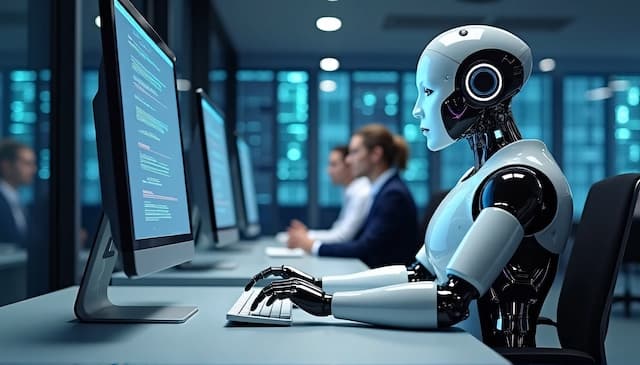

 Priya
Priya
 Arjun
Arjun