 Divya Nair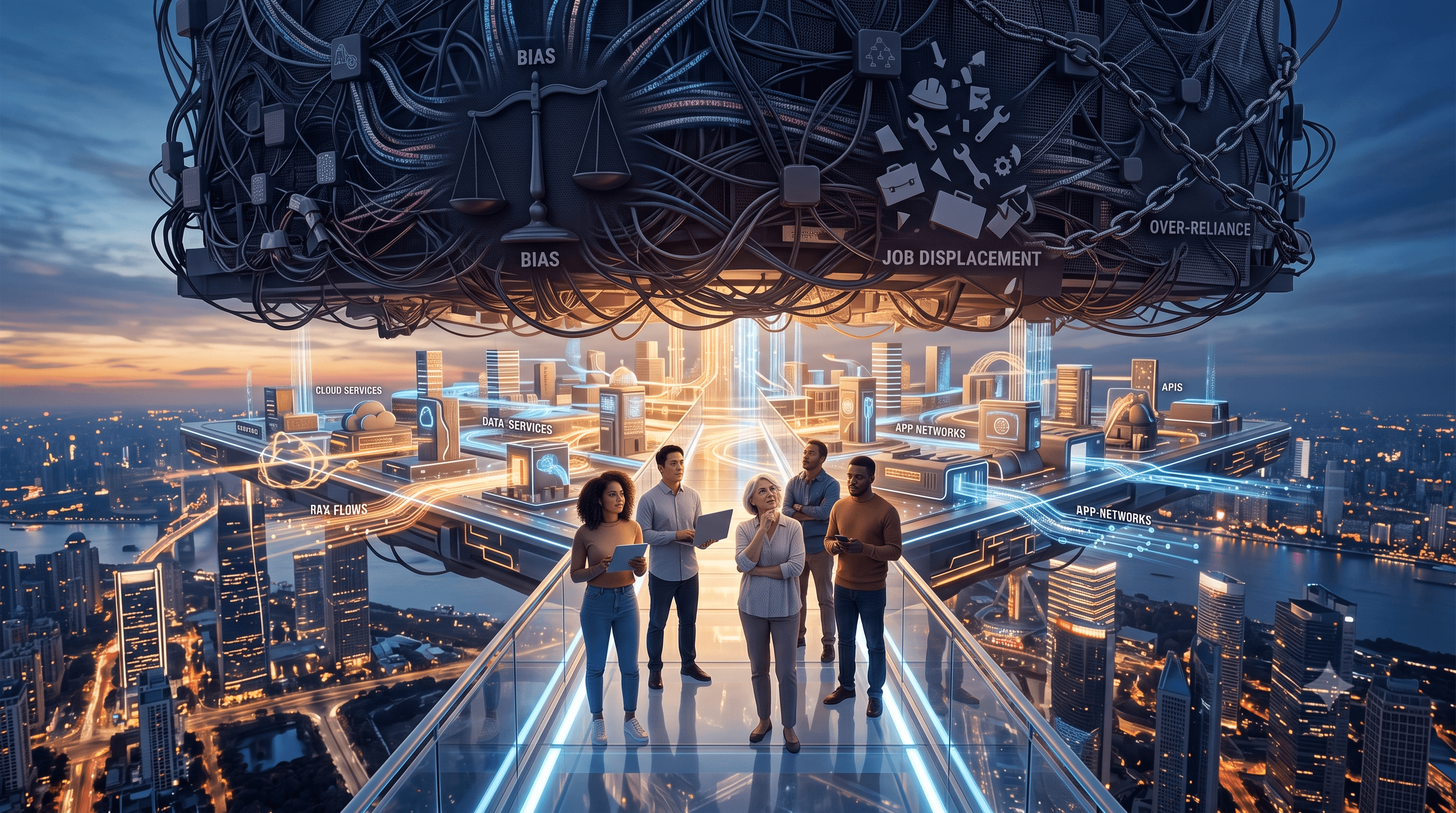
Software: Reality, Awareness, and the Dark Side
Introduction: Why Software Awareness Matters Now
Software is everywhere—in your phone, your bank, your workplace, and even your car—but most people never see how it’s built, who controls it, or what can go wrong.This article is designed for a balanced audience: non-technical readers who want clarity, and people who already work with software who need a reality check. We’ll cover what software really is, where it adds value, and the darker sides that rarely make it into marketing materials.
A key focus is AI-powered software: its promise, its pitfalls, and the real risks around bias, job displacement fears, and over-reliance.The goal isn’t to scare you, but to equip you with a clear perspective so you can make better decisions—as a user, employee, manager, or citizen.
What Software Really Is (and Isn’t)
- Software is instructions that tell hardware what to do. It ranges from simple apps to complex systems running cities, hospitals, and global finance.
- It’s never “finished.” Even “working” software needs updates, security patches, and maintenance; otherwise it becomes fragile and risky.
- It’s a human product, not magic. Software reflects the goals, assumptions, and mistakes of the people and organizations that build and deploy it.
Perspective shift: Stop thinking of software as a flawless tool and start seeing it as a living system that requires care, oversight, and critical thinking.
The Positive Side: How Software Powers Modern Life
Software enables:
- Efficiency and automation: Repetitive tasks get handled faster and more consistently, from payroll to inventory.
- Access to services: Banking, education, healthcare, and government services are increasingly delivered via software platforms.
- Innovation and new jobs: Entire industries (app development, cloud services, data engineering) exist because of software.
- AI-assisted productivity: AI-powered tools can summarize documents, draft content, detect fraud, and support decision-making when used responsibly.
The upside is real: when designed and governed well, software amplifies human capability and expands opportunity.
The Dark Side of Software: What Most People Don’t See
1. Hidden dependencies and fragility
Modern life depends on a small number of critical platforms and services. When they fail, everything from payments to logistics can stall. [50] Many users and even businesses don’t realize how much they rely on third-party software they don’t control.
2. Security and privacy risks
- Data harvesting: “Free” apps and services often monetize user data through targeted advertising and profiling.
- Vulnerabilities: Poorly written or outdated software can be exploited to steal data, disrupt services, or take control of devices.
- Opaque permissions: Users routinely grant broad access without understanding what data is collected or how it’s used.
3. Lock-in and hidden costs
- Vendor lock-in: Switching away from a dominant platform can be technically difficult and expensive, trapping organizations in suboptimal tools.
- Subscription fatigue: What looks cheap initially can become costly over time when multiple tools, add-ons, and tiers stack up.
4. Quality and accountability gaps
- “It works on my machine” syndrome: Software may function in testing but break in real-world conditions, especially under stress or unusual inputs.
- Blame shifting: When things go wrong, responsibility is often unclear—between vendors, integrators, and internal teams.
AI-Powered Software: Promise and Peril
AI-powered software is a special case: it can learn from data, adapt to patterns, and automate complex tasks.But that power comes with distinct risks that affect everyone, not just technologists.
The Positive Side of AI Software
- Enhanced decision support: AI can highlight patterns humans might miss in areas like fraud detection, diagnostics, and maintenance.
- Productivity boosts: Routine writing, coding assistance, data cleaning, and customer support can be partially automated, freeing time for higher-value work.
- Personalization: Recommendations, adaptive learning, and customized experiences can improve usability and outcomes when designed ethically.
The Dark Side: Bias, Job Displacement Fears, and Over-Reliance
1. Bias and unfair outcomes
AI systems learn from historical data, which often contains human biases. This can lead to:
- Unfair hiring or lending decisions
- Discriminatory risk scoring in insurance or law enforcement
- Reinforcement of stereotypes in content recommendations
Even well-intentioned teams can deploy biased systems if they don’t actively test for fairness and representation.
2. Job displacement fears (and reality)
Automation and AI are changing the labor market:
- Some tasks are becoming highly automatable, especially routine, rule-based work.
- Research suggests that while full job elimination is less common than feared, millions of roles face significant exposure, and many jobs will be reshaped.
- New roles emerge (AI oversight, data quality, prompt engineering), but they often require different skills, creating transition challenges.
The realistic picture: not “all jobs will vanish,” but “many jobs will change, and some will shrink or disappear.”
3. Over-reliance and skill erosion
When people trust AI outputs too much:
- Automation bias: Users accept machine recommendations even when they’re wrong, especially under time pressure.
- Skill erosion: Critical thinking, writing, analysis, and debugging skills can weaken if people outsource too much thinking to AI.
- Accountability gaps: Decisions made “by the AI” can become excuses for avoiding responsibility, even though humans chose, deployed, and trusted the system.
Over-reliance is especially dangerous in high-stakes domains like healthcare, finance, and public safety, where errors can have serious consequences.
Common Misconceptions About Software (and the Truth)
1) “Software is easy and quick to build.”
- Reality: Quality software requires careful design, testing, and iteration; cutting corners leads to bugs, security issues, and costly rework.
2) “Once it works, it will work forever.”
- Reality: Software needs ongoing updates, security patches, and adaptation to new environments; otherwise it becomes vulnerable and obsolete.
3) “Adding more people will fix a late project.”
- Reality: Throwing more people at a delayed software project often makes it slower due to coordination and onboarding overhead (Brooks’ Law).
4) “Open-source software is inherently less secure.”
- Reality: Open-source code is visible to many eyes, which can improve security; risk depends on how it’s maintained and used, not just its license.
5) “Automation can replace all manual work.”
- Reality: Automation excels at repetitive, well-defined tasks but struggles with nuanced judgment, creativity, and unexpected situations.
6) “AI is neutral and objective.”
- Reality: AI reflects the data and goals it’s trained on; without careful design, it can amplify existing biases and inequalities. [36][44][50]
7) “If the AI says it, it must be correct.”
- Reality: AI can produce confident but wrong answers; human review and domain expertise remain essential, especially for important decisions.
A Clear Perspective for Non-Technical Readers
- You don’t need to code to be software-literate. Understanding basic concepts—updates, permissions, backups, and data privacy—already makes you safer and more empowered.
- Ask better questions:
- What data does this app collect?
- Who can access it?
- What happens if this service goes down or changes its terms?
- Treat AI outputs as drafts, not final answers. Use them as starting points, then apply your own judgment and fact-checking.
A Clear Perspective for People Who Work With Software
- Design for failure. Assume components will fail, data will be messy, and users will misuse features; build guardrails and fallbacks.
- Document and communicate. Clear docs, runbooks, and honest status updates reduce blame games and help teams respond to incidents.
- Measure and mitigate AI risks. Actively test for bias, track error rates, log decisions, and keep humans in the loop for high-stakes use cases.
- Invest in skills, not just tools. Training people to work with AI (and to question it) is as important as buying the latest platform.
Practical Steps to Use Software (and AI) More Safely
For individuals
- Keep software updated. Enable automatic updates where possible; they often include critical security fixes.
- Review permissions. Regularly check what data your apps can access and remove unnecessary permissions.
- Use strong, unique passwords and a password manager. This dramatically reduces the impact of data breaches.
- Treat AI as a collaborator, not an oracle. Verify important information, especially for health, legal, financial, or career decisions.
For teams and organizations
- Map critical dependencies. Know which third-party services your operations rely on and plan for outages.
- Set AI usage policies. Define where AI is allowed, where it’s forbidden, and what human review is required.
- Monitor for bias and errors. Log outcomes, audit decisions, and create feedback channels for users and employees to report issues.
- Invest in reskilling. Prepare your workforce for changing roles by offering training in data literacy, AI oversight, and new workflows.
Myth vs Reality: Software and AI at a Glance
| Myth | Reality | |---|---| | Software is easy and quick to build | Quality software needs careful design, testing, and iteration; shortcuts create risk | | Once it works, it will work forever | Software requires ongoing updates, security patches, and adaptation | | Open-source is inherently less secure | Security depends on maintenance and usage, not just the license; open-source can be very secure | | Automation can replace all manual work | Automation fits repetitive tasks; nuanced judgment and creativity still need humans] | | AI is neutral and objective | AI reflects its data and design; without care, it can amplify bias and inequality | | If the AI says it, it must be correct | AI can be confidently wrong; human review is essential for important decisions | | More people will fix a late software project | Adding people to a delayed project often slows it further due to coordination costs |
Conclusion: Awareness as a Superpower
Software and AI are not inherently good or evil—they’re tools shaped by human choices.Awareness doesn’t mean rejecting technology; it means using it with eyes open: understanding its limits, questioning its outputs, and demanding better design and governance.
For non-technical readers, this awareness protects your privacy, safety, and opportunities. For people who build and manage software, it’s a responsibility: to create systems that are robust, transparent, and aligned with human values.]
The future won’t be decided by software alone, but by how wisely we choose to build, deploy, and depend on it.

Suggested Posts
All PostsAllAll PostsAll
 Arjun
Arjun

Inside the Race to Build Trustworthy AI: Why Explainability Is Now Non-Negotiable
 Priya
Priya- •
- 02 MIN TO READ