Why Non-Invasive Neurotech Is Becoming the Industry’s Next Big Wave in 2026
 Arjun Verma
- •
- 09 MIN TO READ
Why Non-Invasive Neurotech Is Becoming the Industry’s Next Big Wave in 2026
Introduction
Non-invasive neurotech is moving from experimental promise to practical reality in 2026. What used to sound futuristic is now showing up in real products, clinical pathways, and wearable form factors that fit into everyday life. The biggest reason for this shift is simple: the industry is finding ways to measure and modulate the brain without surgery, while also making the technology more usable, regulated, and commercially viable.
That matters because neurotech has long faced a difficult tradeoff. Invasive systems can be powerful, but they are harder to deploy, more expensive, and limited to narrow clinical settings. Non-invasive systems, by contrast, are becoming easier to wear, easier to prescribe, and easier to scale, which is why 2026 is looking like a breakout year for the category.
What Non-Invasive Neurotech Means
Non-invasive neurotech refers to tools that interact with the nervous system without surgery. These devices may use EEG to read brain activity, ultrasound or electrical stimulation to influence neural circuits, or other external sensing and modulation methods that do not require implanted hardware. The core idea is to make brain technology safer, more accessible, and more practical for real-world use.
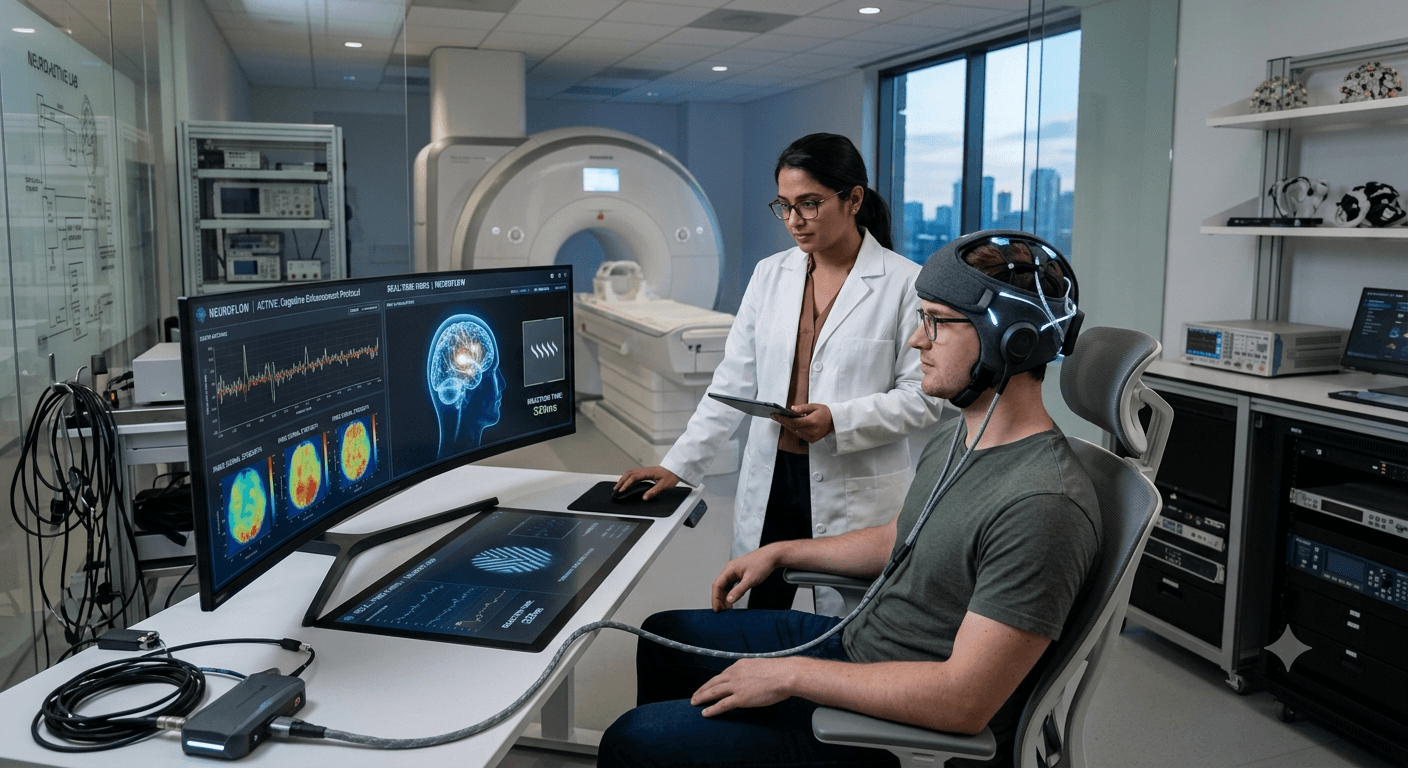
This category includes both brain sensing and brain stimulation. On the sensing side, wearable EEG is moving beyond the clinic and into headsets, earbuds, glasses, and other consumer-friendly devices. On the stimulation side, non-invasive neuromodulation is being explored for depression, sleep, pain, and other conditions where long-term brain or nerve regulation may help.
Why 2026 Is a Turning Point
The reason 2026 stands out is that several trends are converging at once. First, there is clearer regulatory movement, including the approval of at-home prescription neuromodulation for depression. Second, the hardware is becoming more wearable and less clinical. Third, investors and startups are treating non-invasive neurotech as something that can scale beyond research labs.
This combination is important because neurotech does not become mainstream just by being scientifically interesting. It becomes mainstream when the products are usable, the benefits are measurable, and the regulatory path makes sense. That is exactly what seems to be happening now, especially in home-use brain stimulation and wearable neural sensing.
Wearable EEG Goes Mainstream
One of the strongest signals in the market is the rise of wearable EEG. Instead of relying only on point-in-time lab tests, companies are embedding EEG into devices people already wear, such as earbuds and headsets. This turns brain sensing into something continuous, low-friction, and usable in normal daily settings.
This shift matters for a few reasons. It enables longer-term monitoring, which can reveal patterns linked to sleep, stress, focus, or recovery. It also opens the door to new applications in diagnostics, clinical trials, cognitive tracking, and wellness tools. In practical terms, wearable EEG is helping neurotech move from a specialist tool to an everyday interface.
At-Home Brain Stimulation
The other major driver is at-home neuromodulation. In 2025 and 2026, non-invasive stimulation devices began to look less like niche research tools and more like regulated treatment options. A key milestone was the FDA approval of Flow Neuroscience’s at-home prescription treatment for depression, which helped validate the idea that brain stimulation can happen outside the clinic.
That approval is meaningful because it changes the delivery model. Instead of requiring a hospital or specialized center, patients may be able to receive care at home with standard protocols and remote oversight. This opens up a larger market and makes non-invasive neurotech more compatible with real-life treatment routines.
Ultrasound Interfaces and Vagus Stimulation
A second frontier is focused ultrasound and other non-invasive stimulation methods that target neural activity more precisely. These approaches are drawing attention because they promise deeper access to the brain without implants. Some companies are now building “whole-brain interface” concepts around ultrasound, which shows how quickly the field is expanding beyond traditional EEG.
Wearable vagus-nerve stimulation is also gaining traction. Ear-based and head-worn devices are being positioned as clinically studied tools for stress, sleep, mood, and autonomic regulation. This is important because it shows that the non-invasive category is not limited to one technology stack; it includes multiple ways of interacting with neural circuits through external hardware.
AI Makes the Data Usable
AI is another reason the field is accelerating. Neural signals are noisy, complex, and hard to interpret, which means raw data alone is not enough. AI-driven signal processing can clean up EEG, detect useful patterns, and help convert brain activity into meaningful insights or device feedback.
This is especially relevant for wearables, where signal quality can be affected by motion, fit, and everyday use. By combining AI with better electrodes and better device design, companies are making non-invasive neurotech more accurate and more practical. The result is a category that can serve both medical and consumer use cases without depending on invasive hardware.
Clinical Use Cases Expanding
The strongest adoption is happening where non-invasive neurotech can solve a real clinical problem. Depression is one of the most visible examples, but the opportunity set is wider than that. Sleep, pain, epilepsy, cognitive monitoring, and rehabilitation are all areas where external neural sensing or stimulation may add value.
These use cases matter because clinicians need measurable outcomes, not just exciting prototypes. Devices that can show better symptom control, better monitoring, or better adherence have a much better chance of being adopted. That is why the current wave is less about hype and more about building clinically relevant tools with a path to real use.
Why Investors Care
Investors are paying attention because the category is becoming easier to underwrite. Regulatory progress reduces uncertainty, wearable form factors improve distribution, and home-use models create broader revenue potential. In addition, the market narrative has shifted from “Can this work?” to “Which version can scale fastest and safest?”
There is also a strong commercial logic behind non-invasive neurotech. Devices that avoid surgery have a wider addressable market, lower procedural barriers, and better consumer acceptance. That makes them attractive not only for health systems but also for product companies that want to integrate neural sensing into headphones, glasses, and other familiar devices.
Consumer and Clinical Blending
One of the most interesting parts of the wave is that consumer and clinical markets are starting to overlap. A headset that measures attention for productivity can also become a medical-grade monitoring device if the signal quality and validation are strong enough. Similarly, a brain stimulation tool aimed at wellness can evolve into a prescription treatment if the evidence supports it.
This blending creates a powerful growth path. Companies can start with a consumer-friendly design, gather data, refine the technology, and then move into regulated care. That transition is already visible in the market and helps explain why the current generation of neurotech companies looks more commercially mature than earlier waves.
Privacy and Neurodata Risks
As the field grows, privacy becomes a serious issue. Brain and neural data are highly sensitive, and wearable devices can collect information about attention, sleep, stress, and cognitive state. That makes data governance, consent, and security central concerns rather than afterthoughts.
This is one reason regulators and product teams are paying closer attention to neurodata security. If the industry wants to scale, it will need trust as much as it needs better hardware. Devices that handle neural data responsibly will have a stronger chance of being adopted in both clinical and consumer settings.
What Makes the Form Factor Important
Form factor is a huge part of why non-invasive neurotech is gaining momentum. People are far more likely to use a device if it looks and feels like something familiar, such as earbuds, headbands, or a lightweight headset. That is much easier to adopt than an implanted system or a lab-only setup.
This is not just a design preference. It affects adherence, comfort, distribution, and pricing. A product that can fit into everyday routines has a better chance of becoming part of long-term behavior, which is especially valuable in neurotech where repeated use often matters more than one-time intervention.
The Competitive Landscape
The competitive landscape is broadening quickly. Some companies are focused on non-invasive brain stimulation, others on continuous EEG sensing, and others on hybrid systems that combine AI, stimulation, and wearable hardware. This diversity is a sign that the field is maturing rather than narrowing.
At the same time, not every product will survive. Many concepts are still early and will need strong clinical evidence, safer protocols, and better user experience. The winners are likely to be the companies that balance scientific credibility with manufacturable design and real-world utility.
What Comes Next
Over the next few years, the biggest question is not whether non-invasive neurotech will grow, but which use cases will become standard. Depression treatment, sleep monitoring, and cognitive assessment seem like some of the clearest near-term paths. More ambitious ideas, such as ultrasound-based brain interfaces or broader bidirectional communication systems, may take longer to prove out.
Still, the direction is clear. Non-invasive neurotech is becoming more credible because it now sits at the intersection of regulation, usability, AI, and clinical demand. That combination gives it the ingredients for a real industry wave rather than just another cycle of hype.
Conclusion
Non-invasive neurotech is emerging as one of the most important technology stories of 2026 because it solves a fundamental problem: how to make brain technology usable outside the lab. Wearable EEG, at-home stimulation, AI-based signal processing, and improved regulatory pathways are all pushing the field toward real-world adoption.
For readers, the story is bigger than a single product category. It is about a shift in how we think about brain health, brain data, and brain interaction. The next wave of neurotech is likely to be defined not by implants alone, but by devices people can comfortably use in daily life.


 Divya
Divya