
 Priya Sharma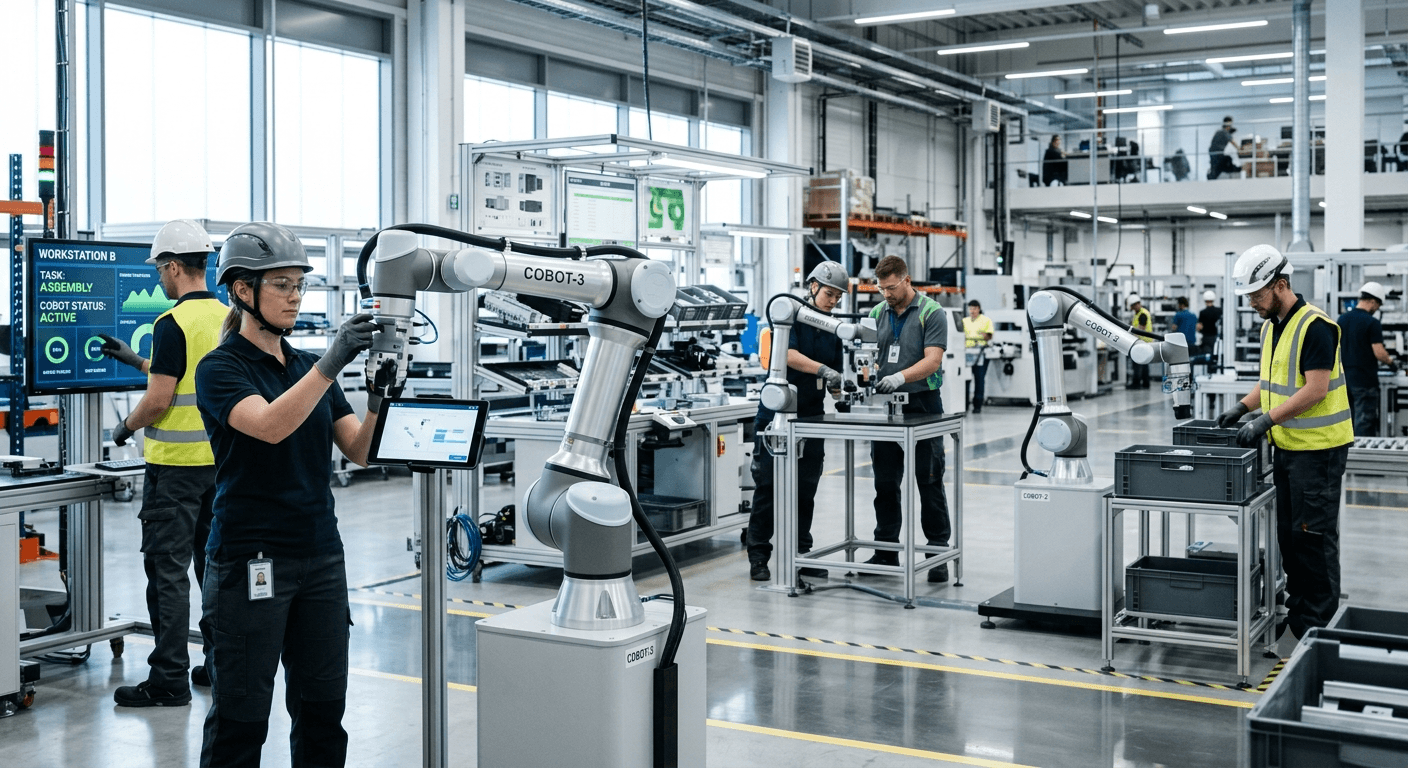
Collaborative Robotics (Cobots) in 2026
Collaborative robotics, commonly known as cobots, has moved from a niche concept to a mainstream automation tool by 2026. Instead of replacing humans entirely, cobots are designed to work alongside people, sharing tasks and complementing human skills. This human-centric approach makes cobots especially attractive for small and medium-sized businesses that want automation without losing flexibility or control.
In 2026, cobots are faster, more accurate, and more capable than early generations. They handle tasks from assembly and packaging to inspection and machine tending, while still being safe enough to operate near human workers. This combination of performance and safety is changing how factories, warehouses, and even non-industrial sectors think about robotics.
What Makes Cobots Different
Traditional industrial robots are powerful, fast, and often separated from humans by cages or barriers. Cobots are different because they are built for direct interaction with people. They use sensors, safety-rated controls, and smart software to limit force, speed, and motion when working near humans.
Cobots trade some raw speed and payload capacity for flexibility, ease of use, and safety. They are easier to install, simpler to program, and can be moved between tasks more quickly. This makes them ideal for environments that change often, where production batches are small, or where human expertise is still central to the workflow.
Key Features of Modern Cobots
Cobots in 2026 include several core features that make them practical and attractive for businesses:
- Built-in safety systems that allow operation without large cages.
- User-friendly programming interfaces that do not require advanced coding skills.
- Compact designs that fit into tight production spaces and existing lines.
- Flexible tooling options, such as grippers, cameras, and sensors, that can be swapped for different tasks.
- Integration with AI and machine vision for more complex decision-making and inspection.
These features reduce the barrier to entry for automation. Companies can start small, test one cobot in a single task, measure performance, and then scale up as needed.
Cobots in Manufacturing
Manufacturing is still the largest sector for cobot usage. In factories, cobots assist with tasks such as:
- Pick-and-place operations for parts and components.
- Assembly of products that require accuracy but not extreme speed.
- Screwing, fastening, and simple joining processes.
- Machine tending, where the cobot loads and unloads parts from CNC machines or presses.
- Packaging and palletizing at the end of the production line.
These tasks are often repetitive and can lead to fatigue or errors when performed manually. By automating them with cobots, manufacturers can improve consistency, reduce worker strain, and free employees to handle more skilled tasks like quality control or process improvement.
Cobots in Logistics and Warehousing
Logistics and warehousing are seeing increasing adoption of cobots as well. In these environments, cobots can:
- Assist with sorting and packing items for orders.
- Work alongside humans on packing stations.
- Help with labeling, sealing, and quality checking packages.
- Operate in fulfillment centers to support high-volume e-commerce operations.
Because cobots are designed to be safe around people, they fit well into busy warehouse floors without requiring complete redesign of the workspace. They also support flexible workflows, which is important as order profiles and product mixes change.
Cobots for Small and Medium Businesses
One of the most important trends in 2026 is the spread of cobots into small and medium-sized enterprises (SMEs). Historically, robotics was seen as too expensive and complex for smaller firms. Cobots change this by offering:
- Lower upfront costs compared to traditional industrial robots.
- Faster installation and shorter setup times.
- Easier programming and reprogramming for new tasks.
- Reduced need for major infrastructure changes.
SMEs use cobots to solve practical problems, such as filling labor gaps, handling repetitive tasks, and improving consistency. This makes cobots a key tool for businesses that want to stay competitive without large automation budgets.
Human-Robot Collaboration
The core idea behind cobots is collaboration, not replacement. In many tasks, humans and cobots share the workload. For example:
- A human positions delicate parts while a cobot performs precise fastening.
- A worker inspects a product while a cobot handles the repetitive movement.
- A technician designs a process, and the cobot executes the routine steps.
This human-robot teamwork improves productivity while keeping human judgment, creativity, and problem-solving at the center of operations. Workers become supervisors, trainers, and process designers rather than just operators of machines.
Safety and Standards
Safety is essential for collaborative robotics. Cobots follow standards that define how they should limit force, speed, and motion when working near humans. Common safety features include:
- Force and torque sensors that detect collisions.
- Speed limits when operating in shared spaces.
- Safe stop functions when something unexpected happens.
- Rounded edges and designs that reduce injury risks.
Modern cobots often work with external safety devices as well, such as light curtains, area scanners, and safety-rated controllers. Together, these systems ensure that collaboration is possible without compromising worker safety.
AI and Machine Vision in Cobots
AI and machine vision are major drivers of cobot capability in 2026. Cobots equipped with cameras and AI models can:
- Recognize parts and adjust to slight variation in position or orientation.
- Perform quality inspection by spotting surface defects or misalignments.
- Adapt to changing tasks by learning patterns rather than following fixed scripts.
- Navigate more complex environments with objects, tools, and humans.
This intelligence moves cobots beyond simple repetitive motions. They can handle tasks with more variability and support smarter decision-making on the factory floor.
Robots-as-a-Service and Cobots
Another important development is the rise of robots-as-a-service (RaaS) models. Instead of buying cobots outright, some companies rent or subscribe to cobot solutions. This offers:
- Lower initial investment and reduced financial risk.
- Access to support, maintenance, and upgrades from the provider.
- Flexibility to scale up or down as business conditions change.
RaaS can be especially attractive for SMEs or firms testing automation for the first time. It allows them to measure the real value of cobots before making long-term commitments.
Applications Beyond Industry
Cobots are increasingly used outside traditional factories and warehouses. Emerging applications include:
- Healthcare support, such as assistance in rehabilitation or handling supplies.
- Food and beverage tasks, like mixing, serving, or packaging.
- Retail environments, including shelf handling or backroom logistics.
- Laboratory automation for repetitive sample handling and testing.
These sectors benefit from the same features that make cobots popular in manufacturing: safety, flexibility, compact size, and adaptability. As more industries experiment with human-robot collaboration, cobots are becoming a general-purpose tool rather than a niche industrial device.
Benefits of Cobots
Cobots deliver several clear benefits for businesses, including:
- Increased productivity by handling repetitive tasks.
- Higher consistency and quality through precise, repeatable movements.
- Reduced worker fatigue and ergonomic issues.
- Faster adaptation to new products or processes.
- More accessible automation for companies that previously avoided robots.
These advantages support both short-term efficiency gains and long-term competitiveness.
Challenges and Limitations
Despite their advantages, cobots are not a perfect fit for every situation. Key challenges include:
- Limited payload and speed compared to heavy-duty industrial robots.
- Need for careful integration to avoid bottlenecks or misaligned workflows.
- Requirement for training and change management for human workers.
- Upfront planning to ensure safety and regulatory compliance.
Businesses must evaluate which tasks truly benefit from collaboration and which still require traditional automation or manual work. Good planning and realistic expectations are essential for successful cobot deployment.
Future of Cobots in 2026 and Beyond
Looking ahead, cobots are expected to become even more capable, connected, and intelligent. Trends include:
- Higher payload cobots that can handle more demanding tasks while remaining safe.
- Better integration with factory software, data platforms, and digital twins.
- More advanced AI that allows cobots to learn from experience and adapt quickly.
- Wider adoption in non-industrial sectors as costs fall and awareness grows.
Cobots will continue to drive a shift toward hybrid workplaces where humans and robots share roles. Instead of replacing people, cobots help build environments where human creativity and robotic precision work together.
Conclusion
Collaborative robotics (cobots) in 2026 marks a turning point in how businesses think about automation. By focusing on safety, flexibility, and human partnership, cobots make robotics accessible to companies of all sizes and across many sectors. As technology improves and adoption spreads, cobots are poised to become one of the most important tools for building efficient, resilient, and human-centered workplaces.

Suggested Posts
All PostsAllAll PostsAll
 Divya
Divya
Soft Robotics Breakthrough Lets Machines Handle Fragile Objects Like Humans
 Arjun
Arjun- •
- 02 MIN TO READ

Why Non-Invasive Neurotech Is Becoming the Industry’s Next Big Wave in 2026
- Arjun
- •
- 09 MIN TO READ